
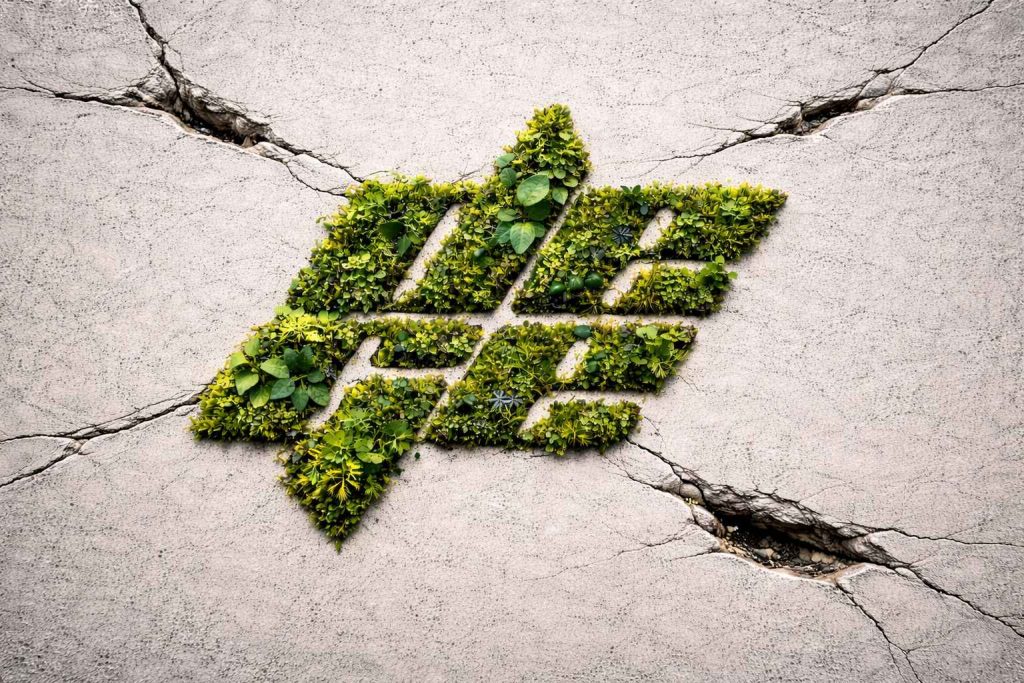
Moss is not a plant in the way we usually understand plants.
It has no roots.
It does not flower.
It does not demand attention.
It persists.
For centuries, moss has occupied cracks, ruins, forests, and shaded stone. It is often overlooked, stepped on, cleaned away. Yet it is one of the oldest and most resilient forms of life on land.
In controlled ecosystems, moss becomes something else entirely:
a surface, a climate indicator, a living skin.
What moss really is
Moss belongs to a group of plants called bryophytes.
They absorb water and nutrients directly through their leaves, not through roots. This makes them highly sensitive to their environment — humidity, light, airflow.
Because of this, moss does not grow everywhere.
It grows where conditions allow.
This sensitivity is precisely what makes moss so powerful in designed systems: it responds immediately to imbalance. When moss thrives, the system is stable. When it fails, something has changed.
Types of moss commonly used in terrariums
Not all moss behaves the same. Each type carries a different texture, growth pattern, and visual density.
Sheet moss
Forms flat, continuous surfaces. Often used to create ground planes or “green concrete” effects.
Cushion moss
Grows in compact, rounded forms. Dense, sculptural, almost architectural in volume.
Feather moss
Lighter, branching structures. Adds depth and softness, especially in vertical or layered compositions.
Mood moss
A common name for several species that react visibly to moisture — contracting when dry, expanding when humid.
Each type can coexist, but only if the system supports it. Moss does not negotiate. It adapts or disappears.
Caring for moss in a closed system
Moss does not need much.
It needs consistency.
- Light: indirect, soft light. Never direct sun.
- Humidity: stable moisture in the air, not soaked surfaces.
- Water: misting, not pouring. Distilled or demineralized water is preferred.
- Air: occasional ventilation in sealed systems to prevent stagnation.
Overcare is the most common mistake. Moss suffers more from intervention than neglect.
In closed terrariums, moss often becomes self-regulating. Once established, it defines the microclimate for everything else inside.
Moss as a design material
In eco-brutalist objects, moss is not decoration.
It is occupation.
It fills fractures. It settles into roughness.
It highlights structural failure instead of hiding it.
Concrete cracks become habitats.
Surface imperfections become points of life.
Moss reveals time. It makes material age visible. It turns static objects into living records.
The quiet wonder of moss
Moss does not grow fast. It does not compete aggressively. It does not dominate.
And yet it survives where other plants cannot.
In a world obsessed with scale, speed, and control, moss operates differently. It teaches patience. It rewards restraint. It makes systems legible.
Moss reminds us that life does not need to be loud to be persistent.
Sometimes, it only needs a crack.